San Francisco Examiner
Martin EdenThe San Francisco Examiner is the first major newspaper to which Martin Eden submits his work, and its response marks an early collision between his ambition and the routines of the literary marketplace. He studies the paper’s Sunday supplement to estimate the length of his first article, imagines prompt publication and substantial payment, and waits for the newspaper to make his return to Oakland known to Ruth Morse. Instead, the article does not appear, and the manuscript eventually comes back without comment. The episode establishes the newspaper as an important early gatekeeper in Martin’s career, though the evidence does not show it publishing his work or paying him.
A model for a first manuscript
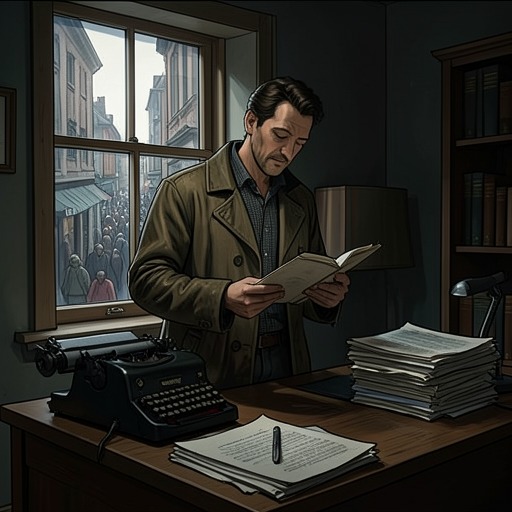
Back in Oakland, Martin settles into his old room at Bernard Higginbotham’s and begins an article about treasure hunters. He intends to finish it before visiting Ruth Morse, and the intensity of his creative work makes it possible, for the time being, to refrain from seeing her. He wants the article to bring him nearer to her, joining his new vocation to his idealized hopes for their future.
To decide how long to write, Martin counts the words in a double-page article in the San Francisco Examiner’s Sunday supplement and uses that as his guide. He completes his narrative in three days, then discovers in a library rhetoric book that he must attend to paragraphs and quotation marks. He rewrites the article while consulting the book, learning about composition as he revises. A newspaper item for beginners teaches him further submission conventions: manuscripts should not be rolled, and they should be written on only one side of the paper. He has already broken both rules, so he copies the piece a third time.
The same beginner’s item states that first-class papers pay a minimum of ten dollars a column. Martin multiplies that rate by the ten columns he expects his article to fill and imagines a hundred dollars. This figure is his estimate, not an offer made by the Examiner. He measures the imagined payment less by what it could buy than by the time and independence it might secure: the ability to keep studying, acquire presentable clothes, and move closer to Ruth.
Submission and expectation
Martin mails the manuscript in a flat envelope addressed to the Examiner’s editor. He assumes that accepted newspaper work appears almost immediately. Because he has sent the article on Friday, he expects to see it in the following Sunday’s paper and plans to let its appearance announce that he has returned. He imagines calling on Ruth that afternoon, making publication serve as both professional proof and personal message.
While waiting, Martin begins planning another piece: an adventure serial for boys. He examines back issues of The Youth’s Companion, calculates the usual length of its installments, and starts a story based on what he knows of whaling. His confidence in this separate project makes the coming Sunday’s expected newspaper appearance no less important, but it does show how quickly he turns from one possible market to another. He believes he can learn the forms editors publish and produce work to meet them.
Nonpublication and delay
On Sunday morning, Martin races to the front door for the Examiner. He searches the many-page paper, reads it again carefully, then folds it and leaves it where it was. The treasure-hunting article is absent. He is glad he has not told anyone about the submission, and revises his expectation: perhaps newspaper publication takes longer than he thought, or perhaps the editor will write to him first because the article lacks news value.
The absence does not immediately halt his work. He spends the day on a pearl-diving article, absorbed in trying to recreate the beauty and romance he feels in its subject, and the Examiner’s failure to print the treasure-hunting piece does not at once discourage him. When he later leaves the unfinished article to sit for high-school examinations, his attention shifts to another demand on his time rather than to any answer from the newspaper.
After a month, Martin writes to the Examiner’s editor about the treasure-hunting manuscript. A week later he writes again. At the end of the fifth week, he goes to San Francisco to call at the office, but a young red-haired office boy prevents him from reaching the editor. The manuscript eventually arrives back by mail, without a rejection slip, explanation, or comment. The silence leaves Martin without guidance about whether the paper rejected the subject, the writing, or the submission itself.
Place in Martin’s literary struggle
The Examiner’s role is specific: it supplies an early standard for Martin’s calculations and an early instance of an editor-controlled entrance to print. His careful revisions demonstrate how much he learns from practical instructions, while the return of the manuscript demonstrates that following such instructions cannot guarantee acceptance. His expectations of instant publication and a hundred-dollar payment belong to his own hopeful arithmetic, not to a promise by the newspaper.
Martin continues submitting work elsewhere. The Youth’s Companion returns his serial, and his writing sent to other newspapers and eastern magazines also meets rejection. Later, the Transcontinental publishes The Ring of Bells but fails to send the promised five dollars, a separate dispute from his dealings with the Examiner. These different outcomes show that publication, rejection, and payment are distinct stages of the literary market; they should not be conflated into a claim that the Examiner published or owed him money.
The contrast grows sharper when Martin’s writing later attracts broad editorial demand. Editors seek his previously rejected essays and offer high prices for work already written. The evidence does not identify the Examiner as one of those later suitors, so its importance remains rooted in the earlier episode: it is the newspaper whose Sunday supplement Martin studies, whose publication he prematurely expects, and whose unexplained return teaches him that effort and confidence do not control an editor’s decision.